

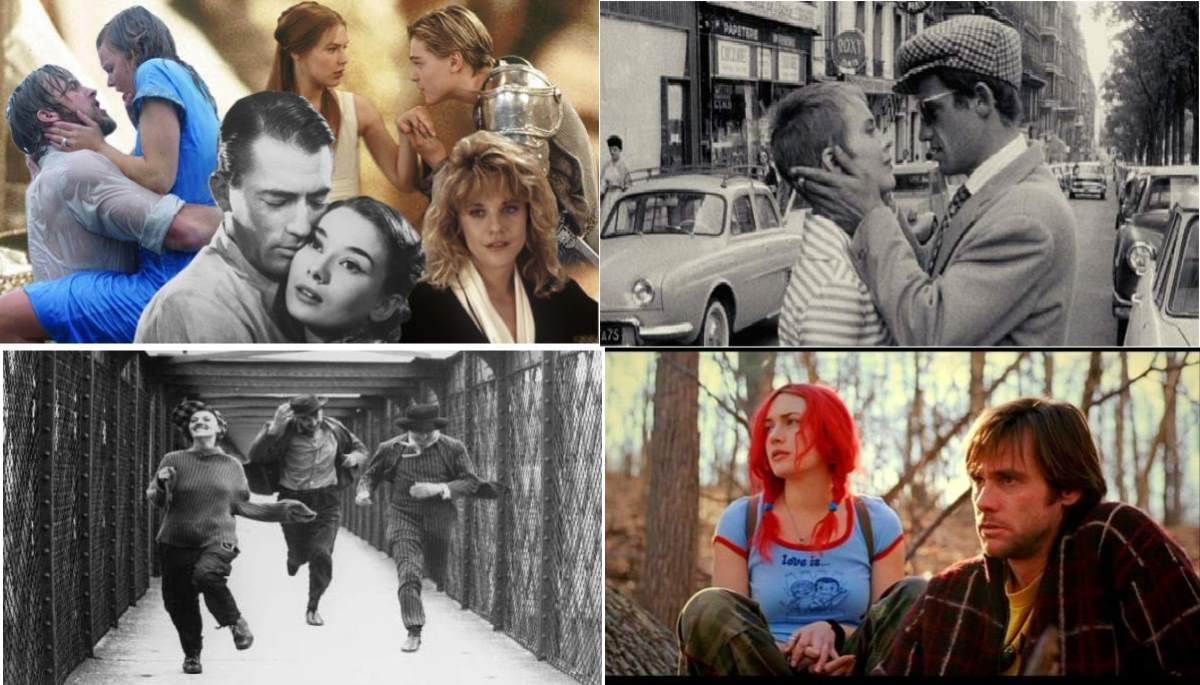
Everyone loves a romantic film, right? Here are the criticisms of the Guardian and the observer, what are the 10 most romantic films of all time. Let us know what you think in the comments below:
Top Movies
This romantic desire provided cinema with some of his most glorious and idealistic films: Casablanca and Brief Encounter are films with a shameless passionate flame, unironic in their centre.
Films such as Gone With the Wind and Doctor Zhivago lent something Grand and epic to romantic love, but maybe it was the beloved weepie An Affair to Remember who made the most to present the innermost of the chick flick idea or film date - the romantic film adored by women and tolerated by their husbands and their cronies.
The romantic comedy was a refinement, almost invented in its modern sense by Woody Allen and revived by Rob Reiner with her success, when Harry met Sally, a success that spawned a thousand imitations of sucrose. In the Mood For Love by Wong Kar - Wai is probably the most powerful, ancient romance of recent times. Tony Leung and Maggie Cheung were this heartbreaking attractive selflessness shown by Humphrey Bogart and Ingrid Bergman or Celia Johnson, Trevor Howard. Love will never go out of fashion.
10. Jules Et Jim
Jules and Jim has been the most successful at the box office of the new wave of French always appreciated. When it is opened in Paris in January 1962, he played for almost three months and found the same crowds everywhere in the world. (In America, two young men were seen, Robert Benton and David Newman, and they began to write a script that would become the Bonnie and Clyde). Although located in the era of the first world war, its sexual mores were an indicator of the upcoming 60, with Catherine (Jeanne Moreau) love and loved by two men (at least) - Jules, a German, played by Oskar Werner and Jim, a french, played by Henri Serre.

Jules and jim
The way of Jules et Jim has emerged was a tribute to Moreau and Truffaut obsession with the idea that women were magical. It is an early dramatization of feminist principles, but it is also the portrait of a bipolar personality drawn to self-destruction. Truffaut, was a perfect balance between the ironic observation and emotional involvement with his own characters. Hardware of the time, the sets and costumes, work very well in a format widescreen, but in truth, it is fatally mercurial temperament of Moreau it holds all together. It was at its peak in the early 1960s, young enough to be sexually irresistible, but wise enough to be a tragic witch. With its sequel less famous, two English girls, is Truffaut at his best. David Thomson
9. The Apartment

The Apartment 1
Some collaborations are so distinctive that the names of those who come to refer to a genre, rather than just a credit. A room with a view, the first of Director James Ivory and adaptations of EM Forster’s the producer Ismail Merchant, was shot before the end of that Merchant-Ivory became an insult; Watch it today and you’re ashamed to have never smiled into the cliché. It is incredibly sweet and film arrest: moving and fun, swooningly romantic and socially fierce - neither more nor less a front (in all senses) aggression on your soul.
Lucy Honeychurch (Helena Bonham Carter) is headed by Baedeker tour of Florence with fussy cousin Charlotte (Maggie Smith) when she meets at the pensione, free-thinking Mr. Emerson (Denholm Elliott) and his dreamy son, George (Julian Sands). Through a series of physical bloody clashes and, worse still, breaches of the sticky label, Lucy desire for emotional freedom begins to bubble, to come to a boil when George the fuck in a corn field. But Charlotte was the snog, so Lucy is taken to Surrey, where she was betrothed to the horribly uptight Cecil Vyse (Daniel Day-Lewis), the expression of polished disgust of his family and the Rev. Beebe (Simon Callow, exceptionally subtle). Then the Emersons will reappear…
This could be starched and talky in other hands out the wash of spring and the spirit. The embrace failed between Lucy and Cecil and the heartbreaking moment when, after being rejected, submits his boots on, are once seen, never forgotten. Charlotte Smith - so funny as a streak of curmudgeonly (“soil will do for me,” says, that the cushions are assigned on a picnic, “I did not have rheumatism for years. And if I feel a pinch, I’ll stand”) - is just tragic alone, as Lucy might well have been, if his story had not been such a happy ending.
8. Hannah and Her Sisters
This tchekhovienne title may have promised Woody Allen to the more pretentious, but this roundelay of 1986 reported $ 40 million and became his biggest hit ever at the box office. The mixture interconnection film intrigues on the three sisters of Manhattan: the warm, well intentioned Hannah (Mia Farrow) is married to the slouch Elliot (Michael Caine), who in turn is attracted to her sister, Lee (Barbara Hershey). As a story begins between the two, specific relationship of Lee with the tormented artist Frederick (Max von Sydow) depends on the strain and light is presented a canvas dark otherwise by ex-husband Hannah, producer of TV fussbudget Mickey (Allen), who becomes involved with another sister Hannah, Holly’s nervousness (Dianne Wiest).

Hannah and her sisters
Then what - this on Hannah who is so successful? The balance between comedy and drama is deftly maintained, and there is a nice aspect to taste soapy to Elliot and Lee’s “case”. The film, with its chapter headings, aspire to a romanesque structure, each party favouring a different character or storyline. And the performances are uniformly subtle, especially Caine (who won the Oscar for best actor) and the Farrow underestimated, who was then a regular Allen and his partners off the screen. Indeed, Farrow brings real mystery to a nurturing figure who is perhaps not as holy as it seems. “Anne was a character, that Mia, nor I understood, at the start and at the finish,” admitted Allen. “We could never figure out that Hannah is the bulwark of the family and of the spine who held everyone together, or if Hannah was not so nice… MIA awaits me for guidance and I could never give it.”
In general, the perfectionist Director was far from happy with the film. “Hannah and her sisters is a film I think I messed up very badly,” he said later. It was the relatively happy outcome which was to blame: “It was the part that killed me.” But after all the characters lived in the pursuit of love and contentment, you could not say that they had not earned. Ryan Gilbey
7. Eternal Sunshine of the Spotless Mind
Boy meets girl. They fall in love. Girl gets enough of boy. Daughter clears all memories of boy of his spirit in a brain-zapping dubious procedure. Boy view and does the same thing. It is a romantic movie, Charlie Kaufman-style. It takes its title from a poem by 1717 Alexander Pope and graphics on the side of love that movies generally try to ignore: the arguments, boredom, irritating habits that drive couples apart and the terrible, stilted moments that accompany a breakup. Love Actually, it isn’t.

Review of the filem Eternal Sunshine of the Spotless Mind
You expect from the writer being John Malkovich and Adaptation, this isn’t the story of a relationship doomed to say in a simple way. Joel Barish is a man removed, greyish, played with unusual restraint by Jim Carrey. Clementine Kruczynski (a brilliant Kate Winslet) is easygoing, reckless and prone to her blue dying hair. When they meet in a train travelling through the winter Long Island in the film’s opening scenes, it is as if they have never met before - but of course they have. The strange attraction that draws them together is the fact that, until very recently, they were in love. Their forgetfulness is the work of Lacuna Inc., a New York company shaded that frees its customers from unwanted memories.

Eternal Sunshine of the Spotless Mind1
Eternal Sunshine was second collaboration of Kaufman with Michel Gondry. The ingenious French filmmaker proved the match perfect script crazy Kaufman, that puts us inside the memories of Joel, as they are stripped away. Concept of the film - that few others can remove after a painful breakup so that they can live in blissful ignorance - seems at first a pessimistic take on love. But the slits of light began to shine through, as memories of Joel of Clementine are systematically sought and zap. He recalled that before the misfortune in, there were happy moments really too and he resumed (too late?) what makes them fall from the other in the first place. Despite all its pitfalls, Kaufman made the love still seem the most precious thing in the world. Veronique renard
6. in the Mood for Love

in the mood for love
Wong Kar - wai takes his time, shooting a movie, exposing without conventional script and waits to see where the mood takes him. its actors rarely have the possession of the bigger picture. As it turned out, it is a love story steamy on two immediate neighbours Cocus (Tony Leung and Maggie Cheung) who falls in love to one another. Returned by regular Director of photography Wong, Christopher Doyle (and then his successor, Mark Lee Ping-bin, who took over when the film came out), the lush colors on screen are softened with nostalgia and refined by the sensuality.
As much as it is the story of love bloom out of rejection, it is also a testament to the ongoing love for its cinema director. What he can do with a passage of music, a close-up or an adjustment of the sensitivity of the film makes most of the other directors unfit to take a piece of the Nativity. Doyle observes meetings provisional behind lamps and cabinets, or under a bed. If you didn’t already know the work of the Director of photography, you might assume Wong had hired a detective to work, if skilled are stealth compositions.
It is a novel unorthodox, widely regarded as the finest work of the Director. And it also impeccably turned out that you would expect from a film by Wong. Audiences may well emerge want props and costumes in the film - the silk and the gossamer dresses worn with a perfect ease of Audrey Hepburn by regal Cheung or the brilliantine giving Leung radiance of Clark Gable, or noodles snazzy-vials with which these fans almost collect their dinner from a basement cafe. Unlike its 2004 sequel semi, 2046, there is more here than just style. A heartbreaking final scene more than justifies the idea that it is a brief encounter for the 21st century.
5. A Room With a View
Fresh out of Some Like It Hot, Director Billy Wilder, his co-writer IAL Diamond and their star, Jack Lemmon, upset straight into the socket of the apartment. Two perfect comedies in a row: how is this for a double whammy? The germ of the idea of the apartment was actually sitting in Wilder specifications for many years, since he viewed Brief Encounter and scribbled the words ‘Film on the qu guy ‘.

a room with a view
CC ‘Bud’ Baxter (Lemmon) is the poor SAP in question. It is growing fast at work, a promotion after another, but the secret of his success is that he prepared out of her apartment for the leaders of companies for their trysts, cleft of 45 minutes at a time. It’s a bit sleazy mount and Wilder keeps the film at a gallop along so strongly that we cannot overlook the inconveniences at the beginning. But the reality then starts to creep that Baxter realizes that the woman he longs to bring home in his arms - gai elevator Fran Kubelik (Shirley MacLaine) Assistant - has already in his apartment, in the company of his boss (Fred MacMurray). The question of how Baxter teaches lets Wilder and diamond demonstrate their talent for succinct narrative: a broken compact mirror is all that it takes to break his heart. They are unbeatable at the turn on these ‘moments’ - witness also of Baxter classic straining-spaghetti-through-a-tennis-racket scene, born of the realization of the diamond that “women like to see a man trying to cook in the kitchen.”
Such scenes are never hinder the precise, fluid film rhythm. Wilder shot the image in 50 flat days and edited in less than a week. “We have three feet of film not used,” he says proudly. It’s funny, fat free film, expertly paced and played, ending with a romantic swoon on ornamentation. He has won five Oscars, including best film, best director and best screenplay. Wilder said it was “the image [of mine] which has the least amount of defects.” Everyone knows as a masterpiece. RG
4.Out of Breath (A Bout de Souffle)
In 1946, Humphrey Bogart had played “Bogey” in The Big Sleep, along with his wife-to-be, Lauren Bacall, a sexy girl available for marriage. Perhaps the dream of Hollywood has never been a more pure, more crazy event. But now, 15 years later: Bogart is dead and, worse still, his Hollywood entered its years of funeral. And then comes Jean-Luc Godard, half in love with this old mythology, half contemptuous of it. Jean-Paul Belmondo, a wonderful Jolt, will model itself on Bogey and take off.

breathless1
Breathless is the first feature film by Godard and his first demonstration of how transform the raiment of the dream of Hollywood upside. In addition to the Godard’s love-hate relationship with Hollywood upward on the wall like graffiti, it is a signal that films could be almost as quickly and cheaply we could write emails. It is therefore important to remember that, while always Breathless desperately feels modern, it was made before the machines of our modern culture.
3. Before Sunrise the Sun/Before Sunset the Sun/before Midnight
An American man and a French woman in her early twenties meet on a train through Europe heading. They get off in Vienna, walk around for 14 hours and shoot the breeze. Yes, the plot of Before Sunrise could be written on the back of a Eurail ticket, but it’s what Celine (Julie Delpy) and Jesse (Ethan Hawke) say and do not say during their bath of Austrian crowd that makes the movie what it is: a fusion of Gen - X soft but cunning of my dinner with André and the romance of permission of Judy Garland, clock.
As the lovers soon-to-be cat, exhibit, lark and Kiss, with the camera by Director Linklater a tender and discreet companion, a sense of vacuum bubbles upwards in the film: we perceive time slips away and Dawn was approaching. When morning arrives, and just time to part, Celine and Jesse promise to meet again in Vienna within the period of six months; at the time pre-Facebook, the arrangement has a heartbreaking fragility.

Before Sunrise Before Sunset Before Midnight
For the 2004 sequel, Before Sunset, we find Jesse, now a writer a success with a novel about a one - night stand, bumping into Celine in Paris. The couple escape on a stroll around the city, but things have changed. Is no longer the things young hope life spread before them, Jesse and Céline must now confess to disappointment and resentment. Even the length of their conversation is narrow; they only have 80-or-so minutes (played in the film in real time) before that Jesse must return to his wife and children to the United States. This sad scenario comes a portrait honest but affectionate of an amorphous romance - not to mention one of the most enticing and ingenious purposes in all the cinema.
And then, very close to a decade later, came the third, before midnight. For those looking for a happy ending: in the meantime, they have become a good couple, living in Paris, but together on the retirement of the writer in Greece. Their worries and concerns are those of the first age means - kids, exes, disappointment - but miraculously, wonderfully, they become ever chagrinees. RG
2 .Casablanca
The unspoken in time of war the most shaking romances of the film is that the image should consider the feelings of the couples separated by the war. It is not fair if they both survive, but whether it’s love and desire can overcome the temptations that come with separate lives. There is another element at work (vital for the romance and the age of censorship in movies), which is only the desire could mean the most when it can not be consumed: the desire for intimacy is so intense, because the Act is forbidden or impossible.

casablanca
In Casablanca, we assume that Rick (Humphrey Bogart) and Ilsa (Ingrid Bergman) had a good sex party in Paris, but in their awkward reunion in North Africa, sex is not renewed. Rather, the triangle of Rick-Ilsa-Victor (Paul Henreid) must consider the final selection of only two of them to go forward. And we now know the decision that Rick is, even if in our enlightened age, one may wonder if Ilsa should have didn’t some of decide. But the romantic or erotic energy is sublimated in the most impeccable cause of all - the war effort. Rick forsakes the Ilsa in its new commitment to the fight against fascism.
Casablanca is synonymous with romance movie in large part because it is almost true to life. He won the Oscar for best film and seemed to be the story coming to life - it opens just after the allies had occupied the real Casablanca. In fact, the rate of divorce and infidelity increased rapidly during the war. But Casablanca reassured us all; He promised that the honour was intact. DT
1. Brief Encounter
How many other countries would choose Brief Encounter as the romance of best film of all time? But for a generation that remembers when the trains ran on time and buffet station were tidy and inviting than this film, Brief Encounter is etched in nostalgia for a time when trapped bourgeois proposed adultery lives but together as thought disorder side. At first glance, it would seem that Britain has changed; but is it possible that David Lean-Noel Coward film is still the model for the feelings repressed as a french ideal? We are used to assign films by directors, but it is not appropriate to consider Coward as an equal author of this film. He wrote the script, he retired from his own play in one Act, still lifes. He made the people of “nice” of prospects (Laura and Alec, a homemaker and a doctor) and clear supporting characters English types - Stanley Holloway.

brief encounter movie
David Lean, meanwhile, triggered a strict Quaker and has always been in rebellion against the restraint - so he was married six times and, on his own, he could have pushed Laura and Alec a degree or two more away loose is comfortable. If it sounds strange, it must be remembered the extent to which Lean was protected by Coward. The young editor had been noticed by Coward and promoted to help lead and resume then lead In Which We Serve, this breed happy, Blithe Spirit and Brief Encounter.
Thus the relationship that begins at Milford station (it is two stops metaphorical on-line Borchester - Archers began five years after Brief Encounter) with a piece of sand in the eyes of Laura and own handkerchief unquestionably Alec will lead to all the afternoon, lunch and a visit to the cinema (his stupid film is called the flames of Passion)a drive of countries one trip awkward at the apartment of a friend (dismissive Valentine Dyall). Nothing happens, and Alec will soon take his family to a new job in South Africa - in 1945 which was still a destination of some hope.
‘Nothing happens’, it is almost a motto for the movies today. But at the end of the second world war, when the halls were crowded, desire on the screen was fabulously (and sometimes hysterical) ignited by self-denial, shyness and censorship. It is a question open, of course, but consider the possibility of this romance film and his dreams of desire, are stimulated by the various controls that blocked the abandonment. These include our innocence. In 1945, there was not a hint of irony or parody in the film beat the score of Rachmaninov (the second piano concerto, played by Eileen Joyce in the handle).
Today, the establishment poses for satire. But brief encounter has survived these threats, because it is so well done, because Laura voiceover narration is really anguished and dreamer, because music suckers each of us and Celia Johnson and Trevor Howard are perfect. I realize, ‘perfect’ seems dangerously prim and old-hat, ultimate proof of the nobility without hope. But this is not just. Howard could be a wild man - as we know from his work - and you feel carefree and revolution as a wind pulling him.
As Celia Johnson, this is due in large part to it that the film is still so touching. His agony and his stay Rapture, Interior and they fail over as nerves in this film in black and white beautiful, serious. His voice is measured, but the eyes are desperate. It cements the movie no doubt
For your feedback:
Email: topxpedia@gmail.com
